Bank credit expands $9.5B despite deposit flight; commercial loans lead at +9.8% YoY
MarketsFN Data Team
The H.8 — Assets and Liabilities of Commercial Banks in the United States — is a weekly statistical release from the Federal Reserve, published every Friday at 4:15 PM ET. It covers the combined balance sheet of all US-chartered commercial banks, covering roughly $19+ trillion in total assets. Because bank credit underpins most economic activity — business investment, home purchases, consumer spending — the H.8 is one of the most closely watched leading indicators of economic health.
Total bank credit ($19.88T today) includes two major components: loans and leases (direct lending to businesses and households) and securities (government bonds, MBS, and other fixed-income holdings). Of the two, loans are the more economically significant — they create new purchasing power. Securities holdings fluctuate with the Fed's QE/QT cycles and banks' liquidity management decisions, not with private sector borrowing demand.
C&I loans ($2.95T, 28% of total) are commercial and industrial loans — credit to businesses for working capital, equipment, and operations. They are a leading indicator of corporate confidence. Real estate loans ($5.83T, 55%) cover mortgages and commercial property. Consumer loans ($1.92T, 18%) include credit cards, auto loans, and student debt — a direct read on household financial health.
The credit/deposit ratio compares total bank credit extended to total deposits held. A ratio above 100% means banks are lending out (or investing in securities) more than they hold in deposits — they must fund the gap via wholesale markets or equity. Currently at 101.6%, this metric signals whether the banking system is in a phase of credit expansion (ratio rising), contraction (falling), or deposit flight (deposits falling faster than credit).
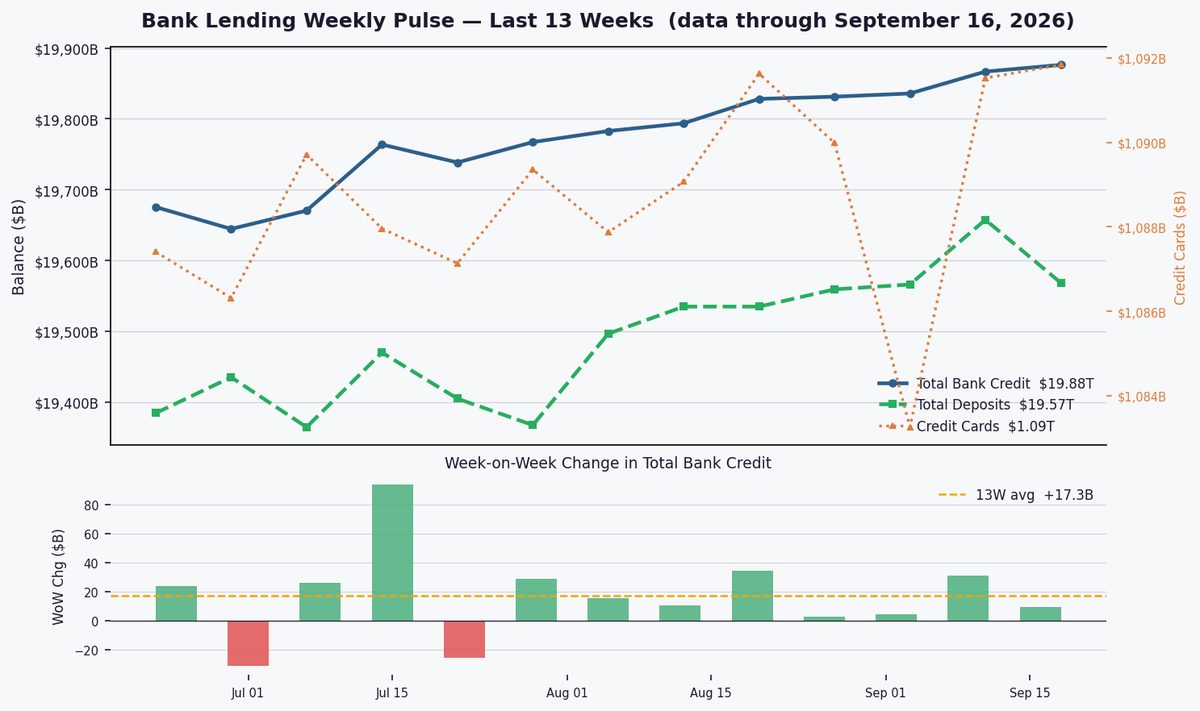
Total bank credit rose to $19.88T (+$9.5B WoW) with a 101.6% credit/deposit ratio, signaling continued lending appetite despite $89.1B deposit outflow, as businesses drive growth with C&I loans surging near double-digits.
Bank credit expanded $9.5B this week, below the 13-week average of +$17.3B, suggesting moderating but still-positive credit creation. Deposits fell sharply (-$89.1B), pressuring bank funding, while credit card loans inched up just $0.3B (3.9% YoY), indicating cautious consumer borrowing rather than stress-driven acceleration.
Commercial & Industrial loans dominate growth at +9.8% YoY ($2.95T), reflecting business investment amid a 3.75% Fed Funds rate, while real estate (+2.6% YoY) lags. Consumer loans (+4.9% YoY) show steady demand, with credit cards' +3.9% YoY suggesting measured spending, not distress, given muted weekly growth.

The 101.6% credit/deposit ratio exceeds the 100.6% 4Y average, indicating tight liquidity as banks fund loans amid deposit outflows. With Fed Funds at 3.75%, higher rates curb deposit flight while sustaining loan demand. Current conditions favor selective credit expansion, particularly for businesses, but margin pressures loom.
Full Statistics Dashboard
| Metric | Latest Value | Change / Context | Frequency |
|---|---|---|---|
| Data through | September 16, 2026 | Weekly H.8 | |
| Total bank credit | $19.88T | ▲ $9.5B WoW +5.8% YoY | Weekly |
| Total deposits | $19.57T | ▼ $89.1B WoW +5.8% YoY | Weekly |
| Credit cards | $1.09T | ▲ $0.3B WoW +3.9% YoY | Weekly |
| Credit / deposit ratio | 101.6% | 4Y avg: 100.6% | Weekly |
| C&I loans | $2.95T | 27.6% of loans +9.8% YoY | Monthly |
| Real estate loans | $5.83T | 54.5% of loans +2.6% YoY | Monthly |
| Consumer loans | $1.92T | 17.9% of loans +4.9% YoY | Monthly |
| Fed Funds Rate | 3.75% | Monthly | |
| Lending signal | EXPANDING | 13W avg WoW: +$17.3B |
Weekly series through September 16, 2026 (H.8 weekly, SA). Monthly categories through August 2026 — published in same H.8 release with ~6-week lag.
Watch September payrolls and CPI for loan demand signals. Credit card growth at 3.9% YoY needs delinquency data to confirm sustainability. A sustained credit/deposit ratio above 102% would flag funding stress, while C&I loan momentum will test Fed policy efficacy in cooling inflation without choking credit.