S&P/NZX 50 Rallies as Asian Markets React to Regional Developments
MarketsFN Team
S&P/NZX 50 Rallies as Asian Markets React to Regional Developments
Note: This analysis covers the Asian trading session close for August 31, 2026. All times are in US Eastern Time (ET).
📊 Asian Indices Performance
| Index | Price | Daily Change (%) |
|---|---|---|
| Shanghai Composite | 3,986.30 | +0.86% |
| Nikkei 225 | 66,311.93 | -0.14% |
| Hang Seng Index | 25,566.99 | -0.07% |
| Shenzhen Component | 14,015.00 | +0.44% |
| KOSPI | 6,820.02 | +0.46% |
| S&P/ASX 200 | 9,076.00 | -0.18% |
| NIFTY 50 | 24,080.40 | -0.39% |
| Straits Times Index | 5,755.36 | +0.97% |
| S&P/NZX 50 | 13,917.30 | +1.08% |
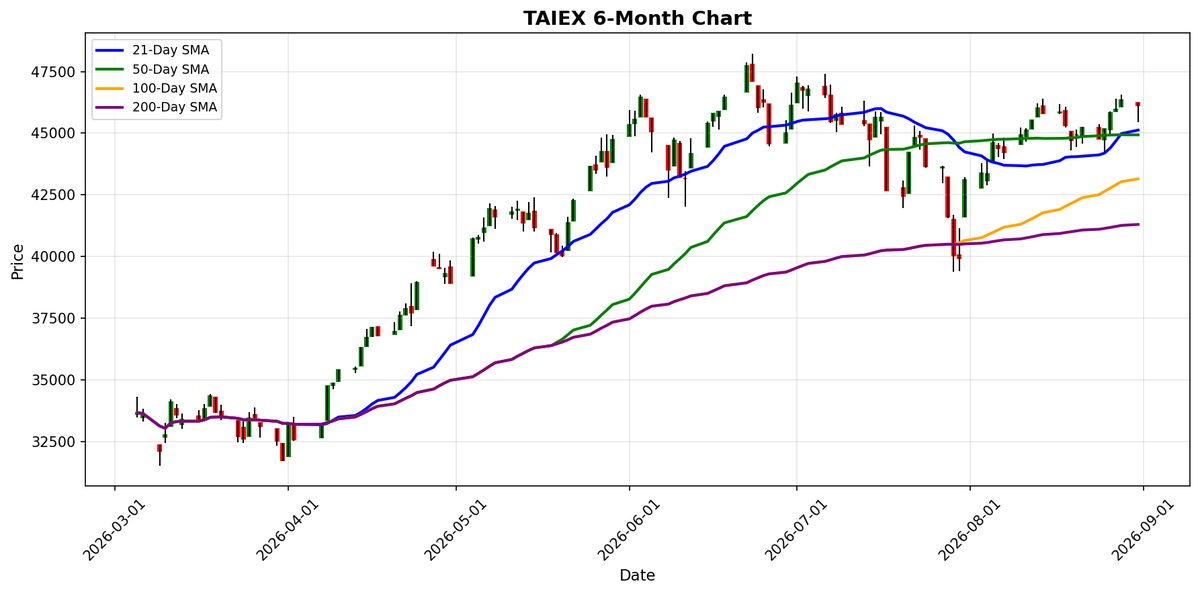
| TAIEX | 46,128.47 | -0.44% |
📰 Market Commentary
As of August 31, 2026, Asian markets are experiencing a mixed performance influenced by a variety of regional developments and key events. ### Key Events Impacting Asian Indices 1. **Japanese Automakers Collaboration**: Nissan and Honda have announced a joint venture to develop software and computer components for vehicles. This collaboration is expected to enhance their competitive edge in the automotive technology sector, potentially boosting investor sentiment towards the automotive industry. 2. **Japan's Record Budget Requests**: The Japanese Defense Ministry has submitted a record budget request of 8.89 trillion yen ($56 billion) for fiscal 2027, alongside a broader budget request of approximately 143 trillion yen ($890 billion). These developments indicate a significant increase in government spending, which may impact investor confidence and market dynamics. 3. **China's Economic Pressures**: China's manufacturing sector continues to face challenges, as factory activity has contracted for the second consecutive month, albeit at a less severe rate than anticipated. This ongoing contraction raises concerns about the sustainability of China's economic recovery and may prompt further government intervention. 4. **Geopolitical Developments**: President Xi Jinping's upcoming visit to Egypt marks a significant strengthening of ties between China and Egypt, which could have implications for regional trade dynamics and economic partnerships. ### Market Sentiment and Price Movements - **Shanghai Composite**: The index rose by 0.86%, reflecting some resilience in the face of economic pressures. - **Nikkei 225**: Japan's index saw a slight decline of 0.14%, likely influenced by the mixed sentiment surrounding government spending and the automotive sector's developments. - **Hang Seng Index**: The index fell by 0.07%, indicating cautious sentiment among investors in Hong Kong. - **Shenzhen Component**: This index increased by 0.44%, suggesting some positive sentiment in the technology sector. - **KOSPI**: South Korea's index rose by 0.46%, buoyed by regional developments and potential tech sector growth. - **NIFTY 50**: India’s index decreased by 0.39%, despite strong economic growth figures, likely reflecting broader market volatility. - **Straits Times Index**: The index increased by 0.97%, indicating a positive market response to local economic conditions. - **S&P/NZX 50**: New Zealand's index saw a rise of 1.08%, reflecting a strong performance in the region. ### Regional Economic Developments - **India's Economic Growth**: India reported a robust economic expansion of 7.8% in the fiscal first quarter, driven by strong performances in financial services, real estate, and IT sectors. This growth outperformed estimates and may lead to increased investor confidence in Indian equities. - **Hong Kong's Real Estate Trends**: The property market in Hong Kong is seeing increased interest from major banks and fashion retailers, taking advantage of lower rents in prime areas. This trend may signal a recovery in consumer confidence and retail activity. - **Tax Incentives in Hong Kong and Singapore**: The competition between Hong Kong and Singapore for investment talent is intensifying, with proposed tax incentives for fund managers in Hong Kong potentially altering the investment landscape. In summary, Asian markets on August 31, 2026, are navigating a complex landscape shaped by significant economic developments, geopolitical events, and mixed market sentiments. The interplay of these factors is likely to influence investor behavior and market trajectories in the near term.
📅 Economic Calendar - Asian Session
All times are in US Eastern Time (ET)
No significant economic events during Asian session.
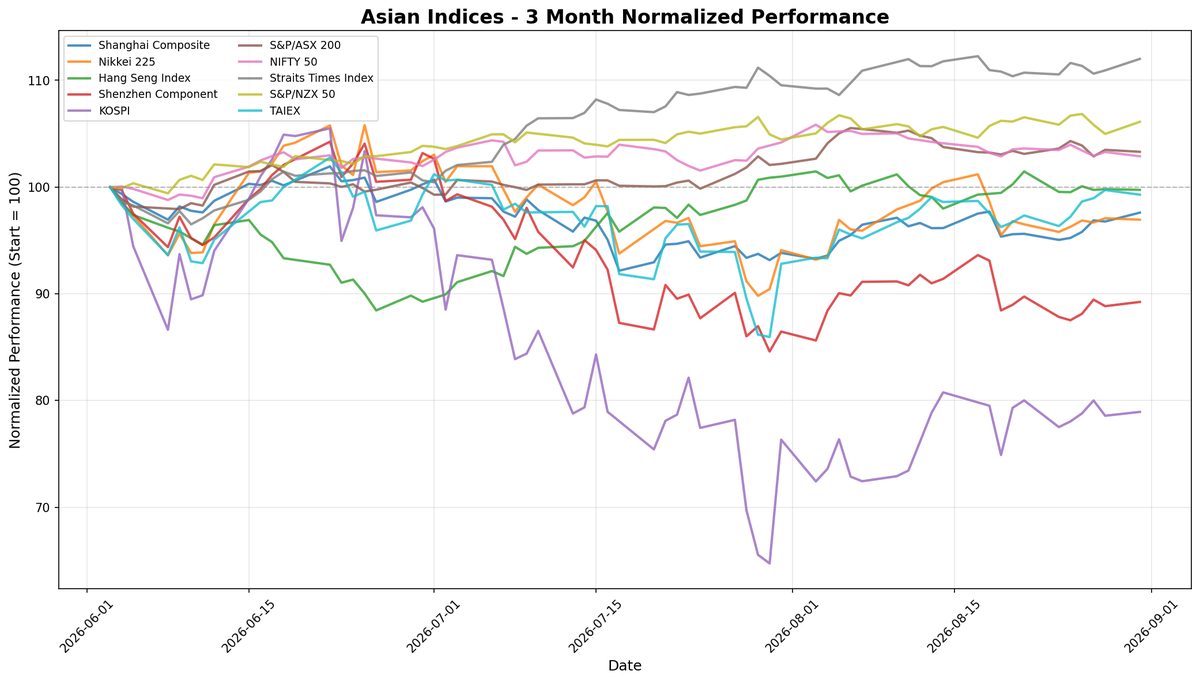
📈 Index Performance Charts
Best Performer: S&P/NZX 50
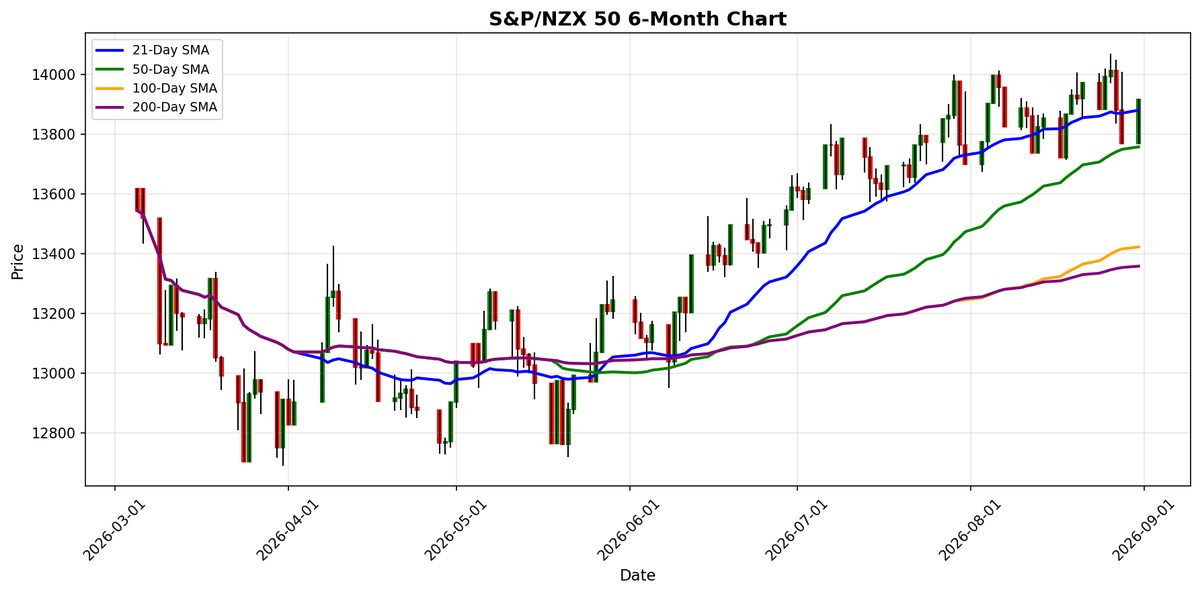
Worst Performer: TAIEX
💱 FX, Commodities & Crypto
**FX Market Summary:** 1. **Key Price Movements:** - **USD/JPY:** Currently trading at 159.8410, showing a slight decline of -0.16%. - **USD/CNY:** Priced at 6.7078, with a daily change of -0.19%. - **AUD/USD:** Holding at 0.7163, reflecting a minimal decrease of -0.01%. - **NZD/USD:** At 0.5917, this pair has seen a slight increase of 0.03%. 2. **Market Drivers:** - The movements in the FX market are influenced by ongoing economic data releases and central bank policies. - The Japanese Yen's performance against the USD is affected by the Bank of Japan's monetary policy stance and inflationary pressures. - The Chinese Yuan's fluctuations are driven by economic growth concerns and trade dynamics. - The Australian and New Zealand Dollars are responding to commodity price trends and global risk sentiment, although specific commodity data is not available for this analysis. Overall, the FX market reflects cautious trading with minor fluctuations across major pairs, influenced by macroeconomic factors and central bank communications.
Currency Pairs
| Pair | Price | Daily Change (%) |
|---|---|---|
| USD/JPY | 159.84 | -0.16% |
| USD/CNY | 6.71 | -0.19% |
| AUD/USD | 0.72 | -0.01% |
| NZD/USD | 0.59 | +0.03% |
Disclaimer
The content on MarketsFN.com is provided for educational and informational purposes only. It does not constitute financial advice, investment recommendations, or trading guidance. All investments involve risks, and past performance does not guarantee future results. You are solely responsible for your investment decisions and should conduct independent research and consult a qualified financial advisor before acting. MarketsFN.com and its authors are not liable for any losses or damages arising from your use of this information.