Fed reserves hit critical $325.8B as QT shrinks balance sheet to $6.75T
MarketsFN Data Team
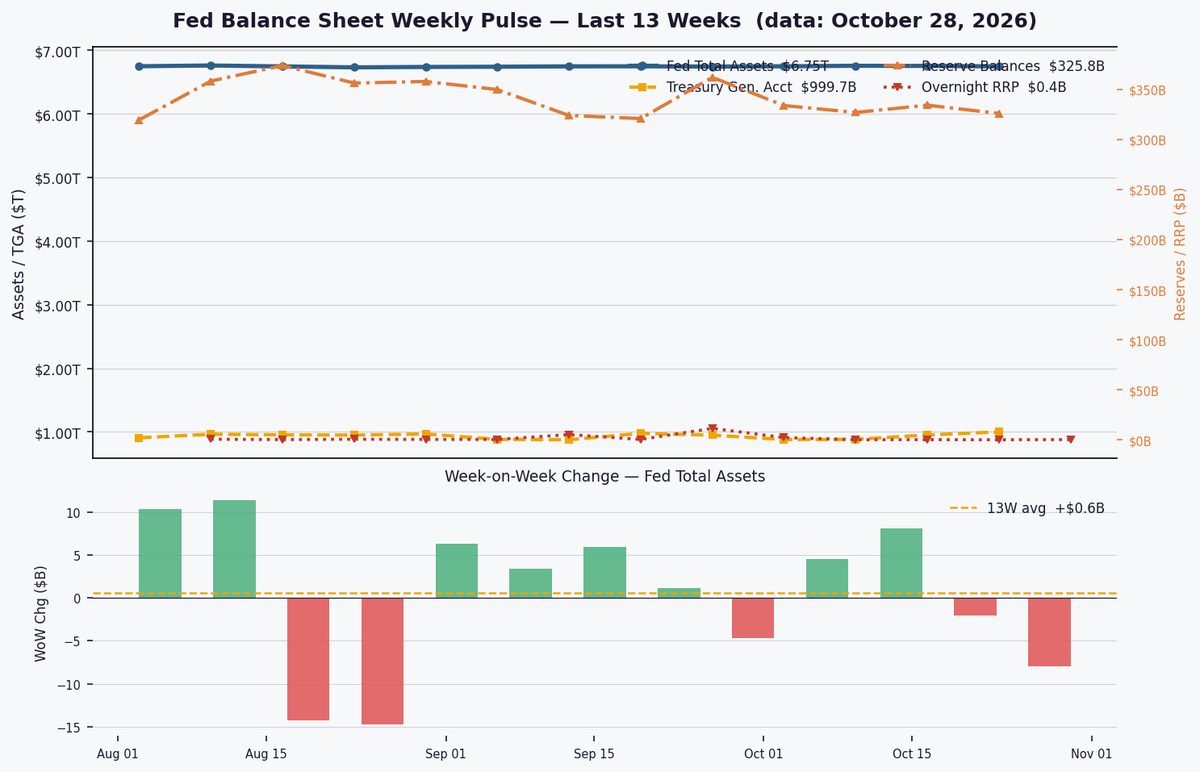
The H.4.1 — Factors Affecting Reserve Balances — is the Federal Reserve's weekly balance sheet statement, released every Thursday at 4:30 PM ET. It shows the Fed's total assets (currently $6.75T) and how those assets are funded (primarily through currency in circulation and bank reserve balances). Tracking the H.4.1 week-by-week reveals the pace of Quantitative Tightening (QT) and how much liquidity the Fed is withdrawing from the financial system.
Quantitative Easing (QE) — the Fed buys Treasuries and MBS, expanding its balance sheet and injecting reserves into banks, making credit cheap and abundant. The Fed's balance sheet peaked at $8.96T in April 2022. Quantitative Tightening (QT) reverses this: the Fed lets bonds mature without reinvesting, shrinking its balance sheet and draining reserves. The Fed has now removed $2.22T (24.8%) from the peak — tightening financial conditions.
Reserve balances are funds that commercial banks hold at the Fed. Currently at $325.8B, they represent the banking system's primary liquidity buffer. When reserves fall too low, banks scramble for overnight funding — exactly what triggered the September 2019 repo market crisis (reserves had fallen to ~$1.4T then). Economists estimate the "ample reserves" floor is around $1,500B. Below that, money market rates can spike unpredictably.
Two key drains on reserves: the Overnight Reverse Repo (RRP) facility, where money market funds park excess cash at the Fed (currently $0.4B, down from a $2.5T peak) — as this drains, that cash re-enters the banking system. The Treasury General Account (TGA) — the government's checking account at the Fed ($999.7B) — drains reserves when it rises (tax receipts) and injects reserves when it falls (government spending). Together, RRP + TGA movements drive weekly reserve volatility.
The Fed's balance sheet fell to $6.75T, down $2.22T (24.8%) from its 2022 peak, with reserves plunging to $325.8B — below critical thresholds and signaling mounting liquidity stress in financial markets.
The Fed has reduced its balance sheet by $2.22T (24.8%) since April 2022's $8.96T peak, with this week's $8.0B decline continuing steady QT. The $6.46T securities portfolio (95.8% of assets) shows Treasury runoff ($4.58T) outpacing MBS ($1.88T), reflecting both passive roll-off and active MBS sales. The current pace remains below the theoretical $95B/month cap, suggesting deliberate caution as reserves dwindle.
Bank reserves at $325.8B have breached critical levels, far below the estimated $1,500B ample-reserves floor and down 4.8% YoY. The near-zero RRP balance ($0.4B vs $2.5T peak) shows exhausted liquidity buffers, mirroring 2019 conditions when reserves below $1.5T triggered repo market stress. The Fed now faces hard choices between maintaining QT and preventing funding market seizures.

The TGA's $999.7B balance (+$47.7B WoW) continues draining reserves as Treasury cash management absorbs liquidity. Each dollar added to the TGA removes a dollar from bank reserves. With seasonal tax receipts and debt ceiling dynamics looming, the TGA could swing sharply — a drawdown would temporarily boost reserves, while further buildup would intensify liquidity pressure.
Full Statistics Dashboard
| Metric | Latest Value | Change / Context | Frequency |
|---|---|---|---|
| Data through | October 28, 2026 | Weekly H.4.1 | |
| Fed total assets | $6.75T | ▼ $8.0B WoW +2.5% YoY | Weekly |
| QT reduction from peak | $2.22T | 24.8% shrinkage from $8.96T peak | |
| Treasury securities | $4.58T | 67.8% of assets | Weekly |
| MBS holdings | $1.88T | 27.9% of assets | Weekly |
| Reserve balances | $325.8B | ▼ $8.2B WoW -4.8% YoY | Weekly |
| Reserve signal | CRITICAL | Ample threshold ~$1,500B · Critical ~$600B | |
| Overnight RRP | $0.4B | ▲ $0.2B WoW (peak ~$2,500B) | Daily |
| Treasury Gen. Account | $999.7B | ▲ $47.7B WoW +4.8% YoY | Weekly |
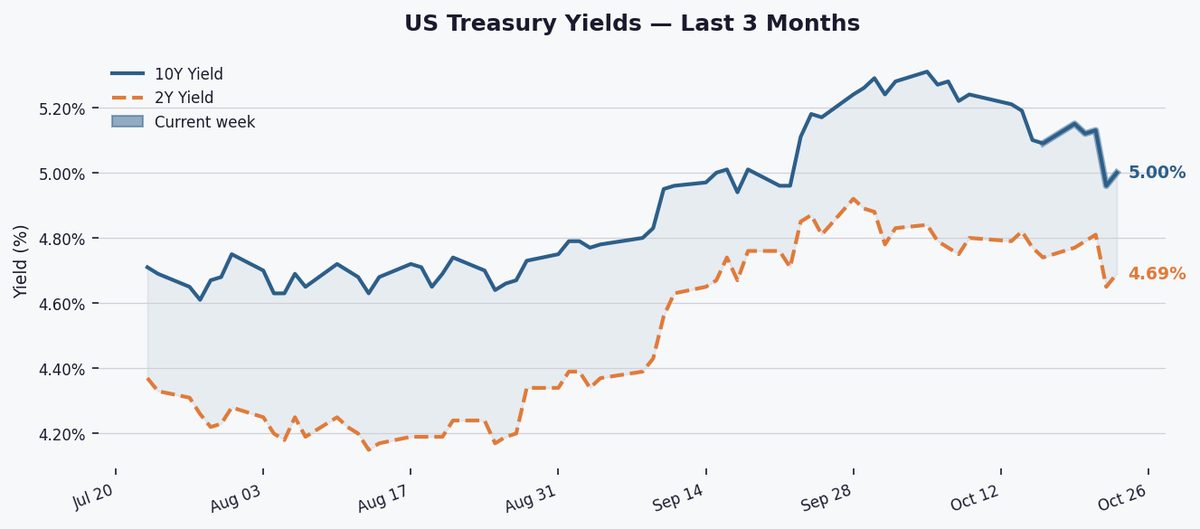
| 10Y Treasury yield | 5.05% | context: QT drains reserves, may pressure yields | Daily |
Markets should watch for FOMC signals on QT adjustments as reserves approach scarcity levels, with $600B likely triggering a pause. Upcoming Treasury issuance and TGA fluctuations will drive near-term reserve volatility, while MBS runoff pace remains key for the balance sheet's structural shrinkage.